Why study at MUICT?
Bachelor of Science in Digital Science and Technology or DST Program is a Thai Program, that focuses on enhancing students’ knowledge and critical skills in Digital Science and Technology. By Integrating theory and practice, students are ensured that they will be able to analyze and solve real problems in the digital industry. The program also focuses on operational training, allowing students to practice hands-on learning with leading digital companies in Thailand. The program’s main disciplines cover bleeding edge technologies: Internet of Things, Data Science, Cyber Security and Software Engineering.
Get A Grip On Tech, Get A Brighter Future @ICT Mahidol
DST Mahidol Admission
Schedules for Academic Year 2027
Round | MU Portfolio (TCAS 1) | Quota (TCAS 2) | Admission (TCAS 3) | Direct Admission (TCAS 4) |
Application Period | Round 1/1 : 17 Aug - 10 Sep 2026 Round 1/2 : - | 22 Mar – 8 Apr 2027 | 7 - 11 May 2027 | Jun 2027 |
Qualifications |
|
- Being a student in an MoU school group or |
| To be announced at |
GPA |
| GPA ≥ 3.00 (5 - 6 semesters) | GPA ≥ 2.50 (6 semesters) | To be announced at |
Online Application | Mahidol Website : https://tcas.mahidol.ac.th/ | Mahidol Website : https://tcas.mahidol.ac.th/ | TCAS Website : https://tcas.mahidol.ac.th/ | To be announced at |
Score & |
| Have one of the following scores
- TGAT scores ≥ 25 in each part
- Math 1 ≥ 20
| Have one of the following scores
- TGAT scores ≥ 25 in each part
- Math 1 ≥ 20 | To be announced at |
Curriculum Information
| Curriculum Information | |
| Name of Study Program | Bachelor of Science in Digital Science and Technology |
| Degree title | |
| Full Title | Bachelor of Science in Digital Science and Technology |
| Abbreviated | B.Sc. (Digital Science and Technology) |
| Total number of credits | 120 Credits |
| Program characteristics | This program is a 4-year full-time undergraduate program (Thai Program). Classes are taught in Thai. Teaching and learning materials as well as textbooks are in Thai and English. |
| Venue to conduct the study | Faculty of Information and Communication Technology, Mahidol University, Salaya campus |
Program Highlights
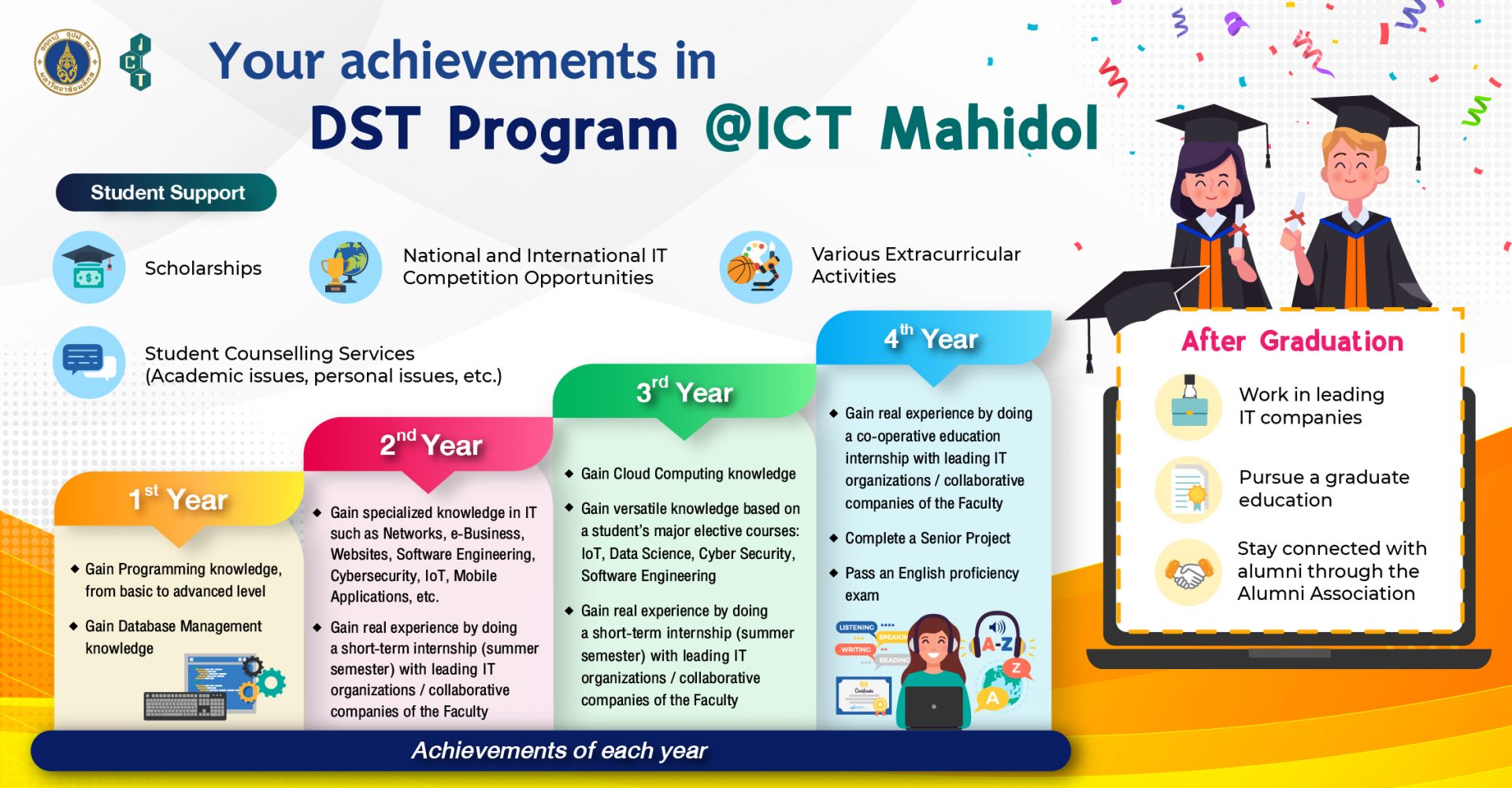
Bachelor of Science in Digital Science and Technology (Thai Program) focuses on enhancing students’ knowledge and critical skills in Digital Science and Technology. By Integrating theory and practice, students are ensured that they will be able to analyze and solve real problems in the digital industry. Furthermore, the program also focuses on operational training, allowing students to practice hands-on learning with leading digital companies in Thailand. The program emphasizes the importance of internships in which the students are required to do their short-term internships (2 months) in the 3rd semesters of their 2nd year and 3rd year, and attend a cooperative education program (4 months) in the 1st semester of their 4th year. In addition, the students are required to conduct senior projects which encourage them to learn and solve problems from real situations in order to prepare themselves for their future career paths.
Main disciplines
1) Internet of Things
2) Data Science
3) Cyber Security
4) Software Engineering
A Selection of Collaborative Companies
1) CDG Group and G-ABLE Group
2) MFEC Public Company Limited
3) Advanced Wireless Network Company Limited
Instructors / Specialists
Instructors from the Faculty of Information and Communication Technology, Mahidol University, and specialists from collaborative companies
Possible careers for graduates
1. Academic Group e.g. Computer Scientist
2. Software Design and Development Group e.g. Programmer, Information System Developer, Software Developer, Software Engineer
3. Data Analysis and Management Group e.g. Data Analyst, Data Scientist, Data Engineer, Artificial Intelligence Engineer
4. Cyber Security Group e.g. Cyber Security System Developer, Cyber Security Engineer, Cyber Threat Prevention Specialist
5. Emerging Technologies and Intelligent Systems Group e.g. Internet of Things System Developer, Internet of Things Application Developer
Philosophy and significance of the program
The program employs an Outcome-Based Education (OBE) approach, utilizing learning-centered education. It emphasizes the student’s process of self-constructing knowledge and skills in digital science and technology (Constructivism). The curriculum is delivered through a blended educational model that integrates academic study within the university with direct, real-world work experience at an enterprise through Cooperative and Work-Integrated Education (CWIE). This setup facilitates learning through practical work, enhancing both academic and professional experience. It ensures that students are equipped with the necessary knowledge, skills, competencies, and attitudes to be “Ready to work” and meet the demands of the labor market and employers.
Program objectives
The program aims to produce graduates who have the following characteristics:
1. Be knowledgeable and skilled in Digital Science and Technology fundamentals, capable of appropriately applying this knowledge to solve problems related to digital technology.
2. Be able to develop digital innovations or solutions in Software Engineering, Data Science, Cyber Security, or the Internet of Things (IoT), and apply them responsibly to solve real-world problems in the digital industry, thereby contributing significantly to the development and competitive capacity of the nation.
3. Possess professional skills and practical experience in Digital Science and Technology gained from real-world work, enabling them to enter the workforce according to the demands of the labor market and entrepreneurs.
4. Be able to communicate professionally in both academic and working contexts within Digital Science and Technology.
5. Possess professional teamwork skills to collaborate effectively.
6. Demonstrate ethics, social responsibility, and respect for the law, especially in areas related to Digital Science and Technology.
7. Be eager to continuously seek experience and knowledge in Digital Science and Technology to adapt to the evolution of technology and society.
Program–level Learning Outcomes: PLOs)
Students are required to pass the following Program Learning Outcomes:
PLO1: Apply fundamental principles of digital science and technology in various contexts to analyze and solve complex technological challenges.
PLO2: Solve problems related to digital science and technology systematically and appropriately in with the given context.
PLO3: Design digital solutions in digital science and technology by analyzing technological trends and user needs or industry requirements, with a focus on specialized areas such as Software Engineering (SE), Data Science (DS), Cybersecurity (CY), or Internet of Things (IoT).
PLO4: Develop digital solutions related to digital science and technology based on the given design, with expertise in areas such as Software Engineering (SE), Data Science (DS), Cybersecurity (CY), or Internet of Things (IoT).
PLO5: Communicate effectively on topics related to digital science and technology for academic and professional contexts through verbal and written channel using both standard and digital media, appropriately tailored to the audience.
PLO6: Demonstrate professional teamwork and collaboration skills within the multidisciplinary team in digital industry to achieve team goals.
PLO7: Demonstrate digital awareness and global citizenship by upholding social and ethical responsibility in academic and professional practices within the domain of digital science and technology.
PLO8: Demonstrate the abilities of lifelong learners who independently acquire emerging knowledge related to digital science and technology.
Educational Management System
A bimester system, with two regular semesters and one special semester (also called the “summer semester”) in an academic year.
Typical class hours
The teaching and learning will be conducted during official hours as follows:
1st Semester: August – December
2nd Semester: January – May
Summer Semester: June – July
*The Faculty may invite outside guest speakers for courses that require practical learning, and may hold classes and laboratory activities during weekends.
Program Structure
Total Credits no less than 120 credits |
|
General Education |
no less than 24 credits |
MU Courses |
21 credits |
| MUGE 100 General Education for Human Development | 3 credits |
| Language Courses | 6 credits |
| MU Literacy Courses | 2 credits |
| 5 Literacy Courses | 10 credits |
DST Courses |
3 credits |
Specific Courses |
no less than 90 credits |
| Core Courses | 51 credits |
| Major Elective Courses | 18 credits |
| Professional Experience Courses | 9 credits |
| Capstone Courses | 12 credits |
Free Elective |
no less than 6 credits |
Study Plan
Major Elective Courses
The Major Elective Courses include 4 disciplines: Internet of Things, Data Science, Cyber Security and Software Engineering. Students can choose any subject in any discipline, in total of no less than 6 subjects (18 credits) as follows:
(1) Internet of Things |
||
| Number of credits (Theory – Practice – Self Study) | ||
| ITDS 331 | Embedded and Cyber-Physical Systems | 3 (2 – 2 – 5) |
| ITDS 334 | Internet of Things Data Analytics and Visualization | 3 (2 – 2 – 5) |
| ITDS 336 | Practical Internet of Things | 3 (0 – 6 – 3) |
| ITDS 337 | Internet of Things Communication Technology | 3 (3 – 0 – 6) |
| ITDS 338 | Internet of Things Security and Privacy | 3 (3 – 0 – 6) |
| ITDS 339 | Special Topic in Network and IoT | 3 (3 – 0 – 6) |
Click here for the specialized course description.
(2) Data Science |
||
| Number of credits (Theory – Practice – Self Study) | ||
| ITDS 340 | Machine Learning for Data Science | 3 (3 – 0 – 6) |
| ITDS 342 | Advanced Mathematics and Statistics for Data Science | 3 (3 – 0 – 6) |
| ITDS 346 | Practical Data Science | 3 (0 – 6 – 3) |
| ITDS 347 | Data Analytics and Business Intelligence | 3 (3 – 0 – 6) |
| ITDS 348 | Deep Learning | 3 (3 – 0 – 6) |
| ITDS 349 | Special Topic in Data Science | 3 (3 – 0 – 6) |
| ITDS 384 | Data Engineering and Infrastructure | 3 (3 – 0 – 6) |
| ITDS 385 | Computer Vision for Industry | 3 (3 – 0 – 6) |
Click here for the specialized course description.
(3) Cyber Security |
||
| Number of credits (Theory – Practice – Self Study) | ||
| ITDS 350 | Advanced Cybersecurity | 3 (3 – 0 – 6) |
| ITDS 354 | Cyber Risk Management and Operation | 3 (3 – 0 – 6) |
| ITDS 356 | Practical Cybersecurity | 3 (0 – 6 – 3) |
| ITDS 358 | IT Auditing | 3 (3 – 0 – 6) |
| ITDS 359 | Special Topic in Cybersecurity | 3 (3 – 0 – 6) |
| ITDS 392 | Secure Software Development | 3 (3 – 0 – 6) |
| ITDS 393 | Fundamentals of Digital Forensics | 3 (3 – 0 – 6) |
Click here for the specialized course description.
(4) Software Engineering |
||
| Number of credits (Theory – Practice – Self Study) | ||
| ITDS 360 | Software Requirement Analysis and Specification | 3 (3 – 0 – 6) |
| ITDS 364 | Software Project Management | 3 (3 – 0 – 6) |
| ITDS 365 | Agile Software Development | 3 (3 – 0 – 6) |
| ITDS 366 | Practical Software Engineering | 3 (0 – 6 – 3) |
| ITDS 367 | Software Design and Development | 3 (3 – 0 – 6) |
| ITDS 368 | Software Quality Assurance and Testing | 3 (3 – 0 – 6) |
| ITDS 369 | Special Topic in Software Engineering | 3 (3 – 0 – 6) |
Click here for the specialized course description.
Download
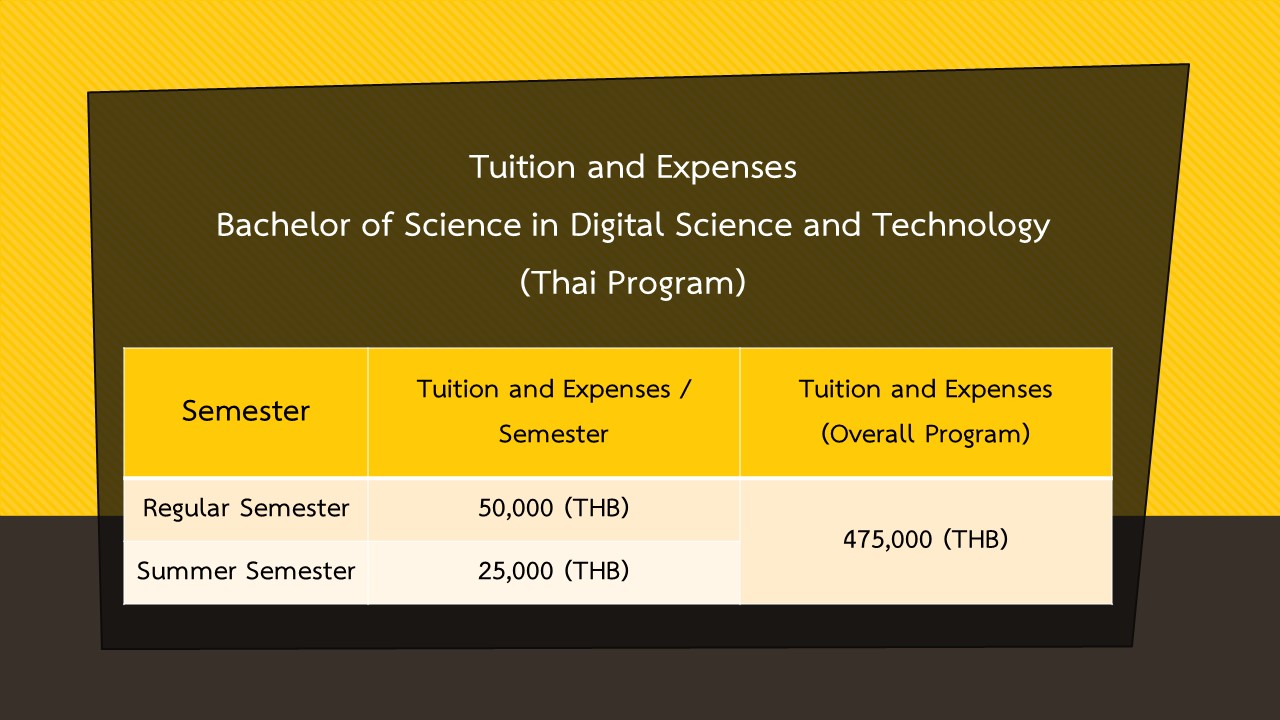
Tuition Fees
Duration of Study / Graduation Requirements
Duration of Graduation 4 years
Graduation Requirements
1. Students who are eligible to obtain a degree of Bachelor of Science in Digital Science and Technology must have fulfilled all of the following requirements:
(1) Complete their study according to the curriculum structure and obtain the grading record satisfying the requirements of the Program.
(2) Pass the English proficiency requirement as announced by Mahidol University.
(3) Achieve at 2.00 cumulative grade point average (GPA) or higher.
(4) Complete their studies within 8 years, (which is twice the normal study duration of 4 years) as required by the Program.
(5) Must not owe any debt to the University.
2. Students who are eligible to graduate with honors with a Bachelor of Science in Digital Science and Technology must have fulfilled all requirements in accordance with Mahidol University Regulations on Diploma and Undergraduate Studies, B.E. 2567 (2024). In addition, this also includes students who enroll in summer semester and/or transfer credits in any semester under exchange programs with partner universities/institutes in other countries which have signed an MoU with the Faculty of ICT or Mahidol University.
3. Students who are eligible to graduate must meet the following requirements:
(1) Be students who received passing grades in all registered courses as required in the program structure.
(2) Pass the requirements of the core courses and core activities as required by the Faculty and Mahidol University
(3) Pass the English proficiency requirement as announced by Mahidol University.
(4) Students who are qualified according to items (1) and (2) are to send a request to graduate to the Registrar Unit by the date and time announced by Mahidol University; otherwise, their names might not be forwarded to the University Council for the approval of their degrees in that semester.
Round 1: MU - Portfolio (TCAS 1)
MU – Portfolio 1/1
Application period : 17 Aug – 10 Sep 2026
MU – Portfolio 1/2
Application period : –
Apply at: https://tcas.mahidol.ac.th/
Educational Qualifications:
- Currently studying or graduated from Thai and international schools:
-
- Matthayom 6, and its equivalent in Science – Math, Arts – Math, Science – Computer, Math – Computer Programs or
- Vocational students with at least 15 credits of computer related courses
2.Have a GPAX from high school, or vocational school of at least 2.50
3.Have an average grade of Science, Mathematics, and English of no less than 2.50 for each subject. (for Matthayom 6 students)
Examination: Thai interview
Additional/Required Documents:
- Portfolio or TCASAFolio in Thai or English, no more than 10 pages. (.pdf file)
- A one A4 page of essay written in Thai or English, on “Why would you like to study further in IT and Computers and how will you apply the knowledge gained in the future?” (.pdf file)
- A 3-minute video presentation in Thai or English. (.mp4 file.)
- A photocopy of completed transcript, 4 semesters with GPAX not less than 2.50 (.pdf file)
- One 1–inch photograph taken not more than six months prior to the application date (.jpg file)
- A photocopy of citizen identification card (.pdf file)
- A photocopy of resident registration (.pdf file)
**Remark: Please upload all documents via online application system only. Students are not required to submit all original documents to the Faculty of ICT.**
Round 2: Quota (TCAS 2)
Application period: 22 March – 8 April 2027
Apply at: https://tcas.mahidol.ac.th/
Educational Qualifications:
- Graduated or currently studying in any program of study in
-
-
- Matthayom 6, and its equivalent or
- Vocational students with at least 15 credits of computer related courses
- In accordance with one of the following conditions:
- Being a student in an MoU school group as follows:
- Assumption Convent School
- Assumption College
- Kanchanapisek Wittayalai Nakhon Pathom School
- Saint Joseph Convent School
- Assumption College Thonburi
- Srinakharinwirot University Prasarnmit Demonstration School
- Nakprasith School Wat Bangchangnua Foundation
- Satriwitthaya 2 School
- Bodindecha (Sing Singhaseni) School
- Kornpitacksuksa School
- Gabriel’s College
- Nawaminthrachinuthit Satriwitthaya Putthamonton School
- Sukhondheerawidh School
- Triamudomsuksa School of the Northeast
- Wat Bowonniwet School
- Wachiratham Sathit School
- Samut Sakhon Burana School
- Maryvit School
- Maryvit Bowin School
- Maryvit Rayong School
- Maryvit Sattahip School
- Jirasartwitthaya School
or
- Passing the POSN Science Camp / Academic Olympiad Camp or
- Having received an award in an IT competition at the provincial level or higher
- Being a student in an MoU school group as follows:
- Have one of the following scores:
-
Additional/Required Documents
- A one A4 page of essay written in English or Thai, on “Why would you like to study further in IT and Computers and how will you apply the knowledge gained in the future?” (.pdf file)
- TGAT scores ≥ 25 in each part, TPAT3 scores ≥ 40 / or A-Level Scores (Math 1 scores ≥ 20, English scores ≥ 30)
- A photocopy of completed transcript or at least 5 semesters with CGPA not less than 3.00 (.pdf file)
- One 1–inch photograph taken not more than six months prior to the application date (.jpg file)
- A photocopy of citizen identification card (.pdf file)
- A photocopy of resident registration (.pdf file)
**Remark: Please upload all documents via online application system only. Students are not required to submit all original documents to the Faculty of ICT.**
Round 3: Admission (TCAS 3)
Application period: 7 -11 May 2027
Apply at : https://www.mytcas.com/
Educational Qualifications:
- Graduated or currently studying in any program of study in
-
- Matthayom 6, and its equivalent or
- Vocational students with at least 15 credits of computer related courses
- Have the following scores:
-
- TGAT, TPAT3
- TGAT scores ≥ 25 in each part
- TPAT3 ≥ 40
- A-Level
- Math 1 ≥ 20
- English ≥ 30
- TGAT, TPAT3
- GPAX: 6 semesters in high school level, not less than 2.50
Additional/Required Documents
- TGAT, TPAT3 Scores and A-Level (Math 1, English)
Admission Criteria
*To be announced*
**Remark: Please upload all documents via online application system only. Students are not required to submit all original documents to the Faculty of ICT.**
Round 4: Direct Admission (TCAS 4)
*To be announced*
Round 1: MU - Portfolio (TCAS 1)
| No. | Activity | Round 1/1 | Round 1/2 |
| 1 | Application Period | 17 Aug – 10 Sep 2026 | TBA |
| 2 | The announcement of applicants who are eligible to take the interview | 29 Oct. 2026 | TBA |
| 3 | Interview examination | 1 Nov. 2026 | TBA |
| 4 | Result announcement (acceptance list and waiting list) | 11 Nov. 2026 | TBA |
| 5 | Students who are accepted to enroll in ICT program (the acceptance list), confirm their status in the MU-TCAS system. | 11 Nov. 2026 08.00 a.m. – 12 Nov. 2026 12.00 p.m. | TBA |
| 6 | Students who are accepted to enroll in ICT program (the waiting list), confirm their status in the MU-TCAS system. | 12 Nov. 2026 12.01 p.m. – 13 Nov. 2026 04.00 p.m. | TBA |
| 7 | Result announcement | 24 Nov 2027 | TBA |
| 8 | Clearing House | 10 -11 Mar 2027 | TBA |
| 9 | Announcement of list of eligible students | 19 Mar. 2027 | TBA |
| 10 | ICT Preparatory Program | June – July 2027 | TBA |
| 11 | Semester starts | Aug 2027 | TBA |
Round 2: Quota (TCAS 2)
| No. | Activity | Date |
| 1 | Application Period | 22 Mar. – 8 Apr. 2027 |
| 2 | The announcement of applicants who are eligible to take the interview | 23 Apr. 2027 |
| 3 | Interview examination | 25 Apr. 2027 |
| 4 | Result announcement (acceptance list and waiting list) | 28 Apr. 2027 |
| 5 | Students who are accepted to enroll in ICT program (the acceptance list), confirm their status in the MU-TCAS system | 28 Apr. 2027 (Time : 08.00 a.m. – 03.00 p.m.) |
| 6 | Students who are accepted to enroll in ICT program (the waiting list), confirm their status in the MU-TCAS system | 28 Apr. 2027 (Time : 03.01 p.m. – 05.30 p.m.) |
| 7 | Announcement of list students who confirmed their status in the MU-TCAS system. | 3 May 2027 |
| 8 | Clearing House | 3 – 4 May 2027 |
| 9 | Announcement of list of eligible students | 14 May 2027 |
| 10 | ICT Preparatory Program | June – July 2027 |
| 11 | Semester starts | Aug 2027 |
Round 3 : Admission (TCAS3)
| No. | Activity | Date |
| 1 | Application Period | 7 – 11 May 2027 |
| 2 | Result announcement | 22 May 2027 |
| 3 | Clearing House | 22 – 23 May 2027 |
| 4 | Announcement of list of eligible students | 9 Jun. 2027 |
| 5 | ICT Preparatory Program | June – July 2027 |
| 6 | Semester starts | Aug 2027 |
Round 4: Direct Admission (TCAS 4)
–TBA–